- Clicker training uses a distinct sound to mark desired behaviors, helping your dog understand exactly what action is being rewarded.
- Clicker training can be used to teach a wide range of behaviors and tricks, from basic commands like sit and stay to more complex tasks.
- The process engages your dog’s mind, increasing their focus and willingness to learn during training sessions, as they anticipate rewards for good behavior.
When it comes to training your puppy or older dog, it is important to make the training experience fun, exciting and not stressful for your dog.
Dogs Can Read You
It is important to remember that your dog can read your facial expressions and body language.
So if you are uncomfortable, stressed, concerned or on edge, your dog will see this, and it can also make your dog’s behavior change.
Try to remain calm, enjoy the training experience and make sure that you and your dog are happy.
If you do feel any of the above emotions/feelings, please take a break.
After all you do want your training experience to be educational, stress free and most importantly of value.
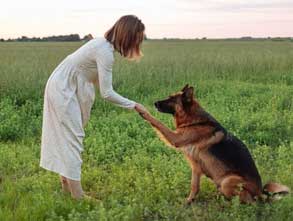
Good Behavior Clicker Rewarding
There are two key areas for rewarding your dog with a click, which is followed by a treat, they are:
Commands
- Sit
- Wait
- Drop
- Leave
- Give (to give item in his/her mouth to your hand)
- Away (to move away from something or somebody)
- Come (off lead command to follow, when distance away)
- Walk (from sitting position)
- Side (walk at side)
Good Behavior:
- Not barking where may normally
- Behaving well around other dogs, people
- Sitting on a designated point
- Goes to bed
- Independently goes and sits quietly somewhere

Introducing Clicker Training
Clicker training is a training method based on positive reinforcement.
In our attempt to change behaviour we often focus on that which we don’t want our dog to do, for instance, ‘don’t pull on the lead Rover’, ‘Rover don’t chew on that’, ‘Rover no barking’, etc.
Clickers are inexpensive, portable, and simple to use, making them an accessible tool for dog owners at all experience levels
Such an approach has been proven to lead to negative interaction between owners and their pets.
But it can also be frustratingly unsuccessful in the long-term modification of behaviour.
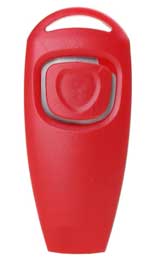 Company of Animals Whizzclick
Good Dog
It is important to understand that you do not have a ‘bad dog’.
You have a dog that is exhibiting normal canine behaviour that you don’t want, therefore this is an unwanted behaviour.
Unwanted behaviors can be modified
This is where clicker training can help you.
By using the clicker you are able to mark exactly which behaviour you want your dog to perform and you can concentrate on rewarding appropriate responses rather than punishing unwanted actions.
Perfect Training Tool
The clicker is a training tool, which produces unique and reliably reproducible sound.
At first the sounds carries no meaning for your dog,.
However it will soon become significant as you teach him/her to associate the clicker with the arrival of something rewarding.
Since dogs often respond positively to food rewards it is good to associate this by following the sound of a click with the arrival of a food treat.
The clicker provides instant feedback, allowing your dog to make the connection between behavior and reward quickly, enhancing learning.
After 20-30 repetitions of click-treat association your dog will begin to learn that the sound of the click predicts the arrival of a food reward.
Once the click-treat association has been established you can use the clicker to mark a behaviour that deserves a reward.
You do this by waiting for the particular behaviour to happen and then reinforcing it with a click-treat when it occurs.
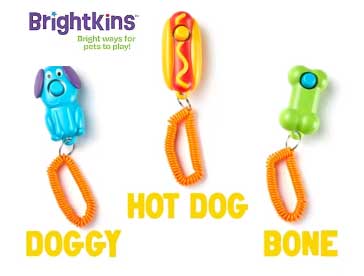 Brightkins Dog Clickers
Examples of wanted behaviour
- When your dog voluntarily ceases to bark, follow this with a click-treat.
- Your dog voluntarily goes down into a sit posture, follow this with a click-treat.
- He/she shows a voluntary action of relaxed behaviour like lying down when you stop to talk to a friend in the park, follow this with a click treat.
Sit, Reward and Repeat
Soon your dog will learn that by offering a particular behavior they can make the click sound go off, resulting in a treat.
In no time at all you will see an increase in the frequency with which behaviour is offered by your dog.
The next stage of training is when you can start to introduce commands to indicate when that specific behaviour is required.
At first the command is only given during the performance of the desired behaviour so that an association is established.

Clicker training combined with positive reinforcement is a highly effective method for teaching dogs new behaviors and commands.
Many pet owners are often curious about how quickly they can expect to see results.
The speed at which a dog responds to this training approach can vary greatly depending on several factors.
These include your dog’s age, previous training experiences, and the consistency of the training sessions.
With dedicated practice, you can see noticeable changes within a few sessions, particularly with simple commands like “sit” or “down.”
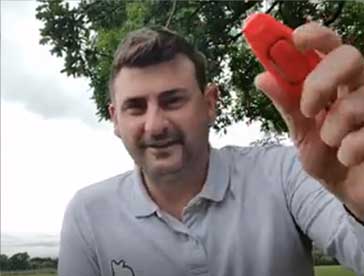
Lee’s Recommendations
- Whizzclick Clicker
- Brightkins Smartypooch Dog-shaped Clicker
- Brightkins Smartypooch Dog Bone-shaped Clicker
Frequently Asked Questions
What is clicker training?
Clicker training is a positive reinforcement training method that uses a small handheld device called a clicker to mark desired behaviors.
The sound of the click signals to the animal that they have done something right and that a reward, usually a treat, will follow.
How does clicker training work?
Clicker training works by creating a clear association between the behavior and the click sound.
When an animal performs a behavior you want to encourage, you click and then deliver a reward.
Over time, your dog learns to associate the click with the reward, making it easier for them to understand what behavior you want.
What animals can be clicker trained?
Clicker training can be used with a wide variety of animals, including dogs, cats, horses, birds, and even some small mammals like rabbits and rats.
The technique is versatile and can be adapted to suit almost any creature.
Do I need to use treats for clicker training?
While treats are the most common form of reward in clicker training, you can also use praise, toys, or other forms of motivation.
The key is to find what your pet enjoys to ensure they are motivated to repeat the desired behavior.
How do I start clicker training my pet?
To start clicker training, first choose a quiet environment with minimal distractions.
Introduce the clicker to your dog by clicking and immediately offering a treat.
Repeat this a few times until understood that the click means a reward is coming.
Once understood, you can begin training specific behaviors.
Is clicker training suitable for all types of behaviors?
Yes, clicker training can be used for a variety of behaviors, from basic commands like “sit” and “stay” to more complex tricks and tasks.
It’s especially effective for behaviors that are hard to achieve through aversive methods.
How long should I train my pet each session?
Training sessions should be kept short, ideally around 5-10 minutes, especially for younger dogs or those new to training.
Go with frequent, shorter sessions as these are more effective than longer ones, as they keep your dog engaged and eager to learn.
Related Topics
- Unique Methods of Dog Training: highly informative article.
- Why Your Dog Needs to Earn Treats: very helpful guide in getting the most from your dog and training.
- Repetition in Dog Training: Helpful guidance and understanding pro’s and con’s.
- 10 Clicker Training Tips
- What to Train?: Useful training guide to begin the journey.
- Choosing a Clicker: Find the best clicker for training.